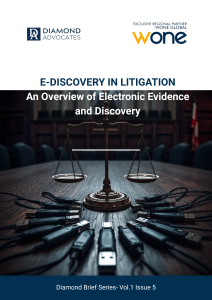
E-DISCOVERY IN LITIGATION: An Overview of Electronic Evidence and Discovery

As digital communications continue to replace paper records, the legal profession can no longer afford to treat electronic discovery as an afterthought.

In our latest Diamond Brief, Vera Nakatumba explores E-Discovery in Litigation, a practical overview of how electronically stored information (ESI) is identified, preserved, collected, and produced in legal proceedings, and what this means for litigants and legal practitioners in Uganda.

Key takeaways from the brief:

πŸ“Œ What qualifies as ESI, from emails and spreadsheets to deleted files and cloud storage
πŸ“Œ The four conditions digital evidence must meet to be admissible in court
πŸ“Œ Uganda’s legal framework: the Electronic Transactions Act, the Data Protection and Privacy Act, and the Evidence Act
πŸ“Œ The 7-stage Electronic Discovery Reference Model (EDRM)
πŸ“Œ How courts balance data protection principles with the evidentiary demands of litigation

E-Discovery is no longer a concern exclusive to large, multinational disputes. As Ugandan courts and businesses become increasingly digital, understanding the rules around electronic evidence is essential for anyone involved in litigation.

Read the full brief below.

Related Posts

Leave a Reply

Your email address will not be published. Required fields are marked *

Diamond Advocates In the Press

Newsletters

Book Appointment

Email us for legal service

Mediation Services

The ALP Conflict Resolution Hub Mediation Service provides the most advanced global rules intended to assist parties and mediators to take maximum advantage of the flexible procedures available in mediation for the resolution of disputes quickly and economically.
The Mediation Service guides parties that opt for Dispute Management Clauses in their project contracts wherein the parties to the contract can jointly appoint a mediator to work together, in a more collaborative and mutually beneficial environment and oversee that their contracts proceed smoothly.

Arbitration Services

The ALP Conflict Resolution Hub Arbitration Service is based on the most efficient Arbitration Rules which help the parties and arbitrator to use the best available global practice for the resolution of domestic and international disputes quickly and economically by way of administered arbitration on global standards.
Additionally, the Arbitration Service provides for the appointment of emergency arbitrators, which allows the parties in need of emergency interim reliefs to make such applications even before the constitution of the regular arbitral tribunal.

Conciliation Services

The ALP Conflict Resolution Hub Conciliation Service provides an impartial, fast and effective conciliation operating to a uniformly high standard in both the public and private sector.
Participation in the Conciliation Service processes is voluntary, and so are the outcomes.Solutions are reached only by consensus whether by negotiation and agreements facilitated between the parties themselves or by the parties agreeing to settlement terms proposed by the Hub Conciliation Officer who treats as confidential all information received during the course of conciliation and the service is informal and non-legalistic in practice.

Ombudsman Services

The ALP Conflict Resolution Hub Ombudsman Service is a confidential, impartial and informal service that facilitates the resolution of disputes. A Hub Ombudsman helps parties analyze problems and assists in identifying options and can, only if requested, become involved in trying to resolve issues.
What’s more, the Hub Ombudsman Service alert managements to systemic trends and issues and makes recommendations for necessary changes in their fields.